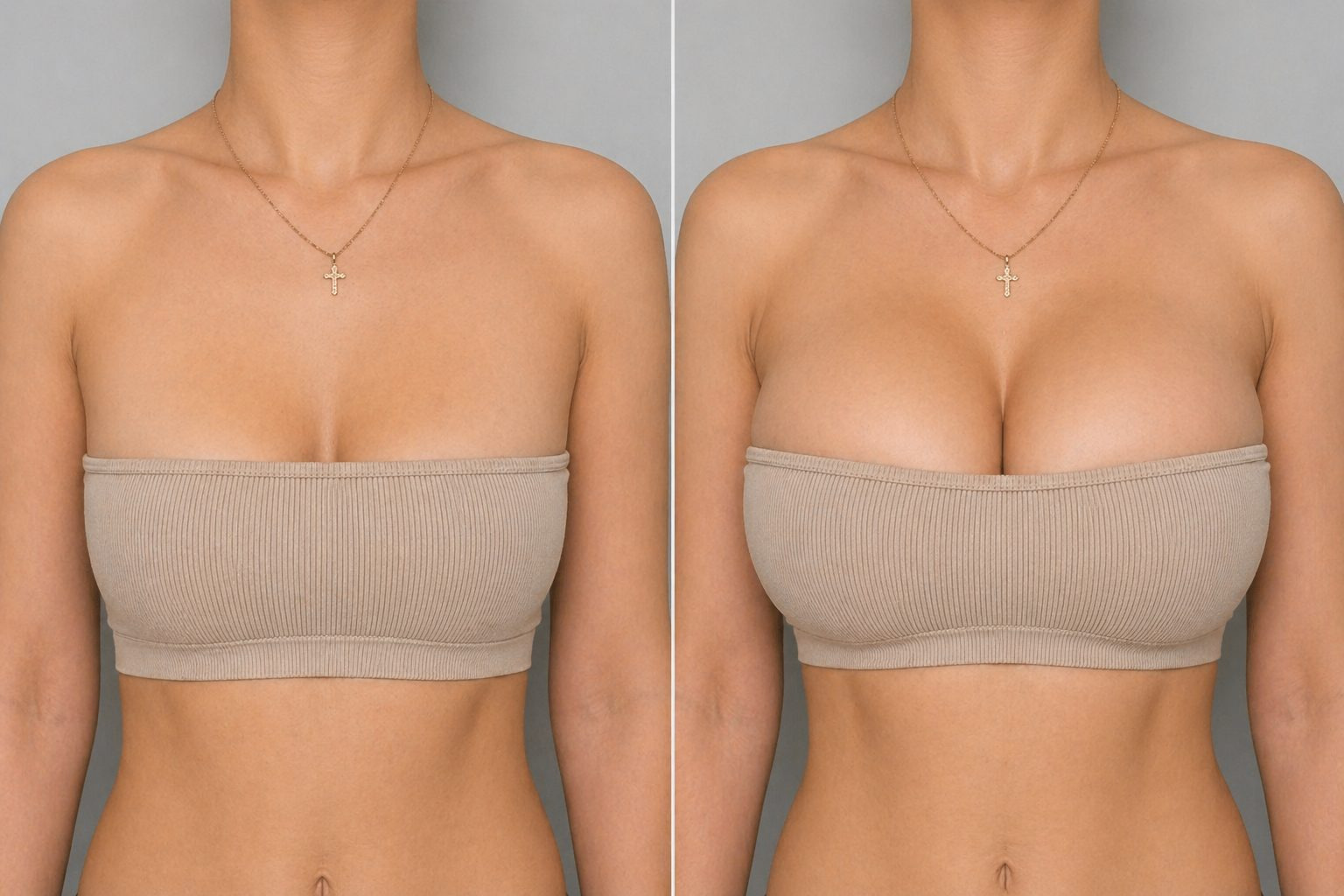
A breast lift — mastopexy — is the operation most patients in Cali misjudge before the first consultation. Many assume implants alone will fix sagging; they can’t. Others assume mastopexy will make their breasts larger; it won’t. A correct lift relocates the breast tissue you already have to a higher, more natural position. Reading the indication correctly is the first job of the consultation and where most disappointing results originate.
Who actually benefits from a mastopexy
The classic candidate has a nipple positioned at or below the inframammary fold. Ptosis is graded I (mild), II (moderate), III (severe). A subtype called “pseudoptosis” describes a breast where the tissue has dropped but the nipple is still high — this needs a different operation entirely.
Three real operations, not interchangeable
- Mastopexy alone — with adequate native volume and significant drop. No implants.
- Augmentation-mastopexy — when both volume loss and ptosis are present, typical after pregnancy or weight loss. The most technically demanding option.
- Implants alone — only valid for pseudoptosis or mild ptosis with severe volume loss.
The scar question, honestly
Every mastopexy leaves a scar. There is no “scarless” lift, regardless of what ads promise. Three patterns are routine:
Periareolar — only around the areola. Limited lifting power.
Vertical / lollipop — periareolar + vertical to the fold. Default for moderate ptosis.
Anchor / inverted-T — adds a horizontal scar in the fold. Reserved for severe ptosis or large skin excess.
Scars mature over 12 to 18 months with silicone sheeting, sun protection, and no tension on the closure.
Internal support: the structural component
A modern mastopexy isn’t skin tightening. The breast tissue is reshaped and anchored with internal sutures, and in selected cases supported with mesh or biologic matrix. That internal scaffolding prevents the result from “bottoming out” in a few years. A surgeon who only tightens skin is using a technique from two decades ago — and that result fails within 2–3 years.
Recovery
Day 1–3: soreness, swelling, sleeping at 45°. Drains, if used, out at day 3–5. Week 1: walking comfortably. Week 2: desk work. Week 4: driving, social events. Week 6: light cardio. Week 8: full gym. Week 12: cleared for upper-body lifting. The breast continues to settle for 6 to 12 months — what looks slightly high at month 1 is by design.
Common mistakes in revision patients
Tightening only the skin — perfect at week 4, disappointing at month 18. Implants too heavy for the soft tissue, causing the lift to fail. Choosing periareolar for moderate ptosis. Aggressive sun on the scar.
Mastopexy prices in Cali (2026)
Mastopexy alone: 7.5 to 11 million COP.
Augmentation-mastopexy (lift + implants one stage): 13 to 18 million COP.
Includes surgeon’s fee, anesthesia, accredited OR, garment, minimum three follow-ups.
Frequently asked questions
Can I breastfeed afterward? Yes in most cases, especially with techniques that preserve the central pedicle.
Will the lift hold? A properly executed mastopexy with internal support holds 10–15 years.
After breastfeeding, when can I have it? Wait at least 6 months after weaning.
Sun? No direct UV on scar lines before 9 months.
The takeaway
A breast lift is structural, not cosmetic. If you’re considering mastopexy in Cali, the first conversation centers on ptosis grade, tissue quality, and the scar pattern your anatomy requires — not cup size.